
From Doe to Roaster: Understanding the Meat Rabbit Production Timeline
Wonderful and productive meat source on the homestead. Rabbits are prolific breeders and are easy to manage and maintain.
1/7/20263 min read
From Doe to Roaster: Our 8-Week Meat Rabbit Timeline
If you’re looking to add livestock to your homestead—especially if you’re working with a smaller space or starting this journey a little later in life like we are—rabbits are a fantastic choice. They don't demand a lot of room, they’re easy on the back, and honestly, they are just a joy to have around when managed right.
Finding Your "Sweet Spot"
One of the first things we learned is that you have to be realistic about your goals. Here at 2 Otters Homestead, we’ve found that two does and one buck are the perfect "sweet spot" for us. Since we grow so much of our own food in other areas of the farm, breeding just twice a year provides more than enough meat for the two of us.
If you have a bigger family or want to fill the freezer faster, that same trio can easily handle a more frequent schedule. It’s all about what works for your table.
Timing is Everything
Rabbits are hardy, but they definitely have a preference: they’d much rather be chilly than hot. We’ve found that breeding in August and February works best for our climate.
The August Batch: By the time the babies (or "kits") arrive in September, the brutal summer heat has usually broken.
The February Batch: This allows the young ones to grow and be ready for harvest before the heavy humidity of summer kicks in.
A Quick (and Slightly Humorous) Mating Process
When it’s breeding day, make sure you have your calendar and a pair of sturdy gloves ready! Even the sweetest rabbit can get a little "scrabbly" and scratch you when they’re excited.
We always bring the doe over to the buck's cage. Does can be a bit like us—they’re very protective of their "home office" and might get grumpy if a buck just barged in! The process is surprisingly fast. When the buck is finished, he’ll actually fall over sideways as if he’s fainted. It’s a bit funny to watch, but it’s the sign of a successful mating. We usually let them breed twice, then move the doe back to her own hutch.
The Magic of the Nest Box
About a week before the 30-day mark, we get the nesting boxes ready with a nice layer of fresh hay. It’s always a bit of a waiting game at this point.
A day or two before she’s ready to give birth (which we call "kindling"), you’ll notice the doe pulling fur from her own chest to line the nest. It’s nature’s way of making a warm, soft bed for the kits. Don’t worry if she waits until the very last second to do this—some of our does are just more "last-minute" decorators than others!
Watching the Little Ones Grow
There’s nothing quite like checking the nest and seeing that fur wiggling.
A Gentle Hands-on Approach: We like to check the kits daily. Don’t be afraid to touch them; if your doe knows you, she usually won't mind. We just look for nice, round, full bellies to make sure they’re getting plenty of milk.
The Hard Parts: It’s worth mentioning that losing a kit now and then is unfortunately part of the process. It’s never easy, but if it happens, it’s best to remove them quickly and let the mom focus on the healthy ones.
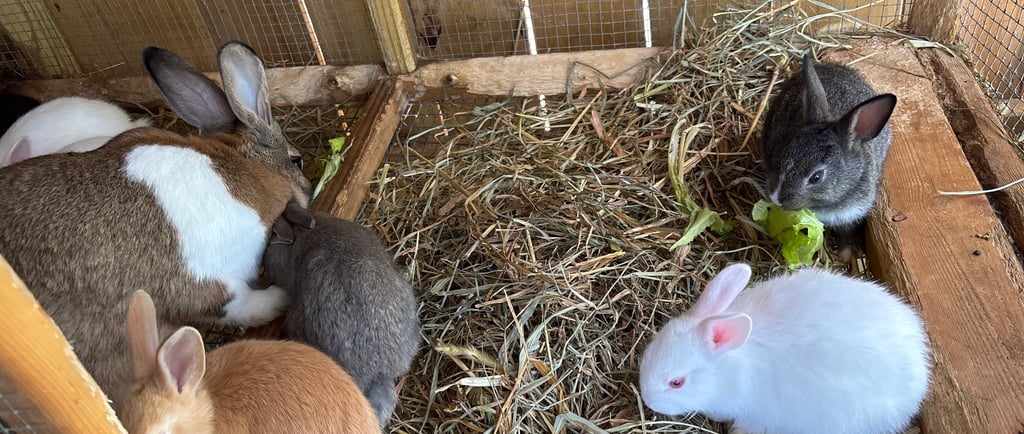
Growing Fast: By the time they’re three weeks old, they get very adventurous and start hopping out of the box to nibble on hay.
The Final Stretch
8 Weeks: This is when we wean the kits and move them to their own space.
10–12 Weeks: We make sure to separate the boys from the girls around this time so we don’t have any "surprise" litters!
16–18 Weeks: While many people process at 12 weeks, we’ve found that waiting a little longer—until about 4 months—gives us a much better yield. At this stage, they usually weigh between 5 and 7 lbs, which makes for a much heartier meal.
Raising meat rabbits has been such a rewarding part of our homesteading journey. It’s a process that feels very connected to the land without requiring a massive amount of heavy labor.
If you're thinking about getting started and have questions, please reach out! We’ve made the mistakes so you don’t have to, and we’re always happy to help a fellow homesteader.